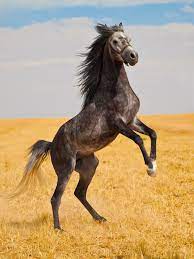

“There is something about the outside of a horse that is good for the inside of a man.” — Winston Churchill.
Horses have walked alongside humanity for thousands of years, serving as warriors, workers, and loyal companions. But beyond their utility, they are breathtakingly beautiful. From the metallic sheen of a desert racer to the flowing mane of a forest giant, the equine world is full of living masterpieces.
If you are a horse lover, an equestrian, or just someone who appreciates nature’s artistry, this list is for you. We’ve curated the top 10 most beautiful horse breeds in the world, diving deep into the unique traits and fascinating histories that make them stand out.
1. The Akhal-Teke
Origin: Turkmenistan
The “Wow” Factor: Metallic “Golden” Coat
Often called the “Supermodel of the Horse World,” the Akhal-Teke is perhaps the most visually distinct horse on the planet. They are famous for their metallic sheen, which makes them look like they are dipped in gold or silver.
-
The Science of Beauty: This shimmer isn’t magic; it’s physics. The structure of their hair shaft is transparent and hollow, acting like a fiber-optic cable that bends and reflects light, creating that signature metallic glow.
-
Legendary Endurance: They aren’t just pretty faces. In 1935, a group of Akhal-Tekes completed a staggering 2,600-mile run from Ashgabat to Moscow in 84 days. This journey included a three-day crossing of the Kara-Kum desert with almost no water—a feat no other breed could match.
2. The Friesian
Origin: Netherlands
The “Wow” Factor: All-Black Coat and Flowing Mane
If you’ve seen a horse in a fantasy movie (like Zorro or Ladyhawke), it was likely a Friesian. Known as the “Black Pearl of the Netherlands,” these horses are almost exclusively jet black with no white markings allowed.
-
Distinct Features: They possess a “Baroque” build—muscular and arched necks—combined with incredibly thick manes and tails that can reach the ground. They also have “feathers” (long hair) on their lower legs.
-
Historical Twist: In the Middle Ages, ancestors of the Friesian were the preferred warhorses of knights in armor. Today, their high-stepping trot makes them favorites in dressage and Hollywood films.
3. The Arabian
Origin: Arabian Peninsula
The “Wow” Factor: The Dished Face and High Tail Carriage
The Arabian is the aristocrat of the equine world. It is one of the oldest breeds in existence, with a silhouette that is instantly recognizable: a concave (dished) face, large expressive eyes, and a tail carried high like a flag.
-
The Legend of Al Khamsa: Folklore tells of the Prophet Muhammad, who tested his horses by keeping them from water for days. When he finally released them toward an oasis, he sounded a battle horn. Only five mares stopped and returned to him, ignoring their thirst. These five faithful mares, known as Al Khamsa, are said to be the mothers of all Arabian bloodlines.
-
Genetic Design: They have one fewer rib, one fewer lumbar vertebra, and one fewer tail bone than other horses, contributing to their short backs and unique stamina.
4. The Gypsy Vanner
Origin: Great Britain and Ireland
The “Wow” Factor: The “Painted” Look and Heavy Feathering
Bred by the Romani people to pull their colorful living wagons (vardos), the Gypsy Vanner (or Gypsy Cob) is a small draft horse that looks like a plush toy come to life.
-
Visual Splendor: They are widely loved for their piebald (black and white) or skewbald (brown and white) coats. But their most defining feature is the profuse feathering that starts at the knees and covers their hooves, making them look like they are floating on clouds.
-
Temperament: They are often called “Golden Retrievers with hooves” because of their incredibly docile and friendly nature, bred to be safe around the children who lived in the camps.
5. The Andalusian (PRE)
Origin: Spain
The “Wow” Factor: Royal Presence and Greying Coat
The Andalusian, or Pure Spanish Horse (PRE), is the horse of kings. For centuries, every European court wanted these horses for their combination of power and elegance.
-
The Look: While they can be other colors, they are most famous for being a brilliant white-grey. They have a natural, high-stepping gait that makes them look like they are dancing.
-
Cultural Icon: If you see a statue of a king riding a horse, check the neck. If it’s thick and arched, the sculptor likely modeled it after an Andalusian. They are the genetic ancestors of many New World breeds, including the Mustang.
6. The Appaloosa
Origin: United States (Pacific Northwest)
The “Wow” Factor: Leopard Spots
The Appaloosa is famous for its spotted coat, which can range from a “blanket” on the hips to full-body leopard spots.
-
The History: Developed by the Nez Perce tribe, these horses were originally called “Palouse horses” (after the Palouse River), which eventually slurred into “Appaloosa.”
-
Unique Identifiers: How do you know it’s a true Appaloosa and not just a spotty pony? Look for the “mottled” skin around the muzzle, striped hooves, and a white sclera (the human-like white part of the eye), which is rare in other horses.
7. The Marwari
Origin: India (Jodhpur region)
The “Wow” Factor: Inward-Curving Ears
The Marwari is a rare and exotic breed that was the warrior steed of the Rathore rulers of Rajasthan.
-
The Ears: The most striking feature of the Marwari is its ears. They curve inward so sharply that the tips often touch, forming a perfect heart shape above the horse’s head.
-
A Hero’s Tale: The breed is immortalized by Chetak, the horse of the warrior Maharana Pratap. Legend says that in the Battle of Haldighati (1576), Chetak was wounded but still jumped a massive river to carry his master to safety, dying in his arms. To this day, Marwari horses are symbols of loyalty.
8. The Black Forest Horse
Origin: Germany (Black Forest region)
The “Wow” Factor: Dark Chestnut with a Flaxen Mane
Known in German as the Schwarzwälder Kaltblut, this breed is a “light draft” horse that looks like a fairytale creature from the deep woods.
-
The Contrast: They are almost exclusively bred for a specific look: a rich, dark “liver” chestnut body contrasted with a golden-white (flaxen) mane and tail.
-
Rarity: They are an endangered breed. For years, they were the “tractors” of the forest, pulling logs through steep terrain where machines couldn’t go. Today, they are a beloved cultural treasure in southern Germany.
9. The Rocky Mountain Horse
Origin: United States (Kentucky)
The “Wow” Factor: Chocolate Coat with Silver Mane
Despite the name, this breed originated in the Appalachian Mountains of Kentucky. They are prized for a specific color known as “Chocolate Silver.”
-
The Silver Dapple Gene: A unique genetic trait turns their black base coat into a rich chocolate brown and dilutes their mane and tail to a shimmering silver or flaxen color.
-
The Ride: They are a “gaited” breed, meaning they don’t trot. Instead, they perform a smooth four-beat amble that is so comfortable you could hold a full cup of coffee in the saddle without spilling a drop.
10. The Haflinger
Origin: Austria and Northern Italy
The “Wow” Factor: The Golden Pony
The Haflinger is a small, sturdy mountain horse that charms everyone with its uniformity.
-
Always Golden: You will never see a black or bay Haflinger. They are always chestnut with a flaxen mane and tail.
-
“The Tractor of the Alps”: Don’t let their cute, pony-like appearance fool you. They were bred to work on steep mountain slopes and are incredibly strong. In fact, they are the first horse to ever be cloned (a mare named Prometea in 2003), proving their genetic value!
Conclusion: Beauty is Subjective
Whether it’s the war-ready build of the Friesian or the delicate refinement of the Arabian, beauty in the equine world serves a purpose. These breeds developed their stunning looks through centuries of adaptation to their environments—from the scorching deserts of Turkmenistan to the frozen forests of Germany.
Which of these beautiful horses would you want to ride into the sunset? Let us know in the comments below!
People Also Ask (FAQ)
What is the rarest beautiful horse?
The Akhal-Teke and the Marwari are among the rarest. The Akhal-Teke has a population of less than 7,000 worldwide, while the Marwari was forbidden from being exported from India for decades, making it extremely rare outside its home country.
Which horse is considered the “most expensive”?
While racehorses (Thoroughbreds) sell for the most money based on potential winnings, the Friesian and Arabian are often the most expensive breeds to buy for show and personal riding due to their beauty and lineage.
Are golden horses real?
Yes! The “golden” look is usually caused by the Champagne gene or the Cream gene (Palomino). However, the Akhal-Teke has a unique hair structure that creates a true metallic iridescence unlike any other breed.

Comments are closed.