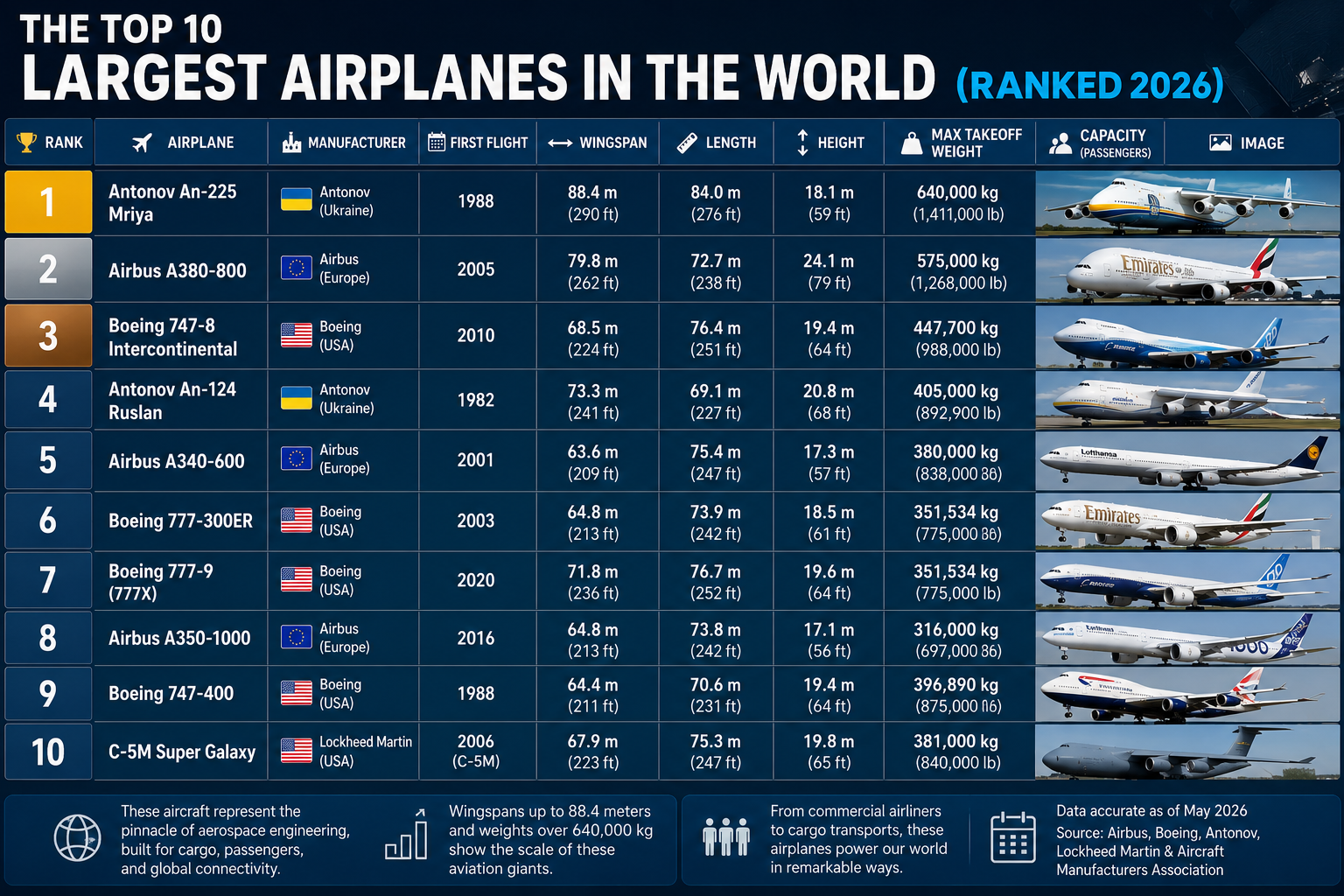

There is something primal about seeing a massive aircraft defy gravity. It doesn’t look like physics; it looks like magic.
But the leaderboard for “world’s largest plane” has changed drastically in the last few years. We lost the King (the An-225), we gained a new twin-fuselage monster, and we are seeing the rise of “folding wings” at commercial airports.
“Largest” is a tricky word in aviation. Do you measure by weight, length, or wingspan? To give you the real picture, we are ranking these based on a mix of sheer physical footprint and legendary status.
Here are the 10 biggest metal birds ever to grace the sky.
1. Scaled Composites Stratolaunch (“Roc”)
-
Wingspan: 117 m (385 ft)
-
Status: Active (The Wingspan Champion)
-
The Vibe: A Flying Catamaran
The Real Story:
If you parked this plane on a football field, its wings would hang over the goalposts on both ends. Named “Roc” after the mythical bird of prey, this isn’t a cargo plane; it’s a flying launchpad.
It has two fuselages (cockpits), six Boeing 747 engines, and looks like two planes holding hands. Its sole purpose is to carry hypersonic vehicles high into the atmosphere and drop them.
2025 Update: As of 2025, the Roc is actively flying test missions for hypersonic gliders (Talon-A). Seeing it fly is unsettling—it looks too wide to be real, like a glitch in the sky.
2. Antonov An-225 Mriya (“The Dream”)
-
Max Takeoff Weight: 640 tonnes
-
Status: Destroyed (2022) / Legend
-
The Vibe: The Fallen King
The Real Story:
We can’t write this list without honoring the King. For 30 years, Mriya was the heaviest, strongest aircraft on Earth. It was built by the Soviets to piggyback their space shuttle (the Buran).
Tragically, it was destroyed during the early days of the conflict in Ukraine in 2022 while sitting in its hangar.
The “Ghost” Project: While there is talk of rebuilding it using a second, unfinished hull from the Cold War era, as of 2025, Mriya exists only in history books and flight simulators. It remains the heaviest aircraft ever to leave the ground.
3. Airbus A380-800
-
Capacity: Up to 853 passengers
-
Status: Active (Production Ended)
-
The Vibe: The Flying Hotel
The Real Story:
This is the plane that tried to kill the concept of “turbulence” with sheer mass. The A380 is a true double-decker—two full levels running the entire length of the fuselage.
The Pilot’s Secret: It is surprisingly agile. Despite looking like a whale, pilots say it flies like a much smaller jet thanks to advanced fly-by-wire computers. While production stopped in 2021, you’ll still see hundreds of them in 2025, mostly wearing the Emirates livery, reminding us of an era when size mattered more than fuel efficiency.
4. Antonov An-124 Ruslan
-
Payload: 150 tonnes
-
Status: Active Workhorse
-
The Vibe: The Squat Bodybuilder
The Real Story:
With the An-225 gone, the An-124 Ruslan is now the heavy-lifting champion of the world. It looks like the An-225’s younger, slightly smaller brother (it has 4 engines instead of 6).
Why it’s cool: It can “kneel.” The nose gear collapses to lower the front ramp, allowing tanks, trains, and even other airplanes to drive straight into its mouth. If you need to move a locomotive across the Atlantic tomorrow, this is the only phone number you call.
5. Boeing 747-8
-
Length: 76.3 m (250 ft)
-
Status: Active (The Longest Commercial Jet)
-
The Vibe: The Queen’s Final Form
The Real Story:
The classic 747 “Jumbo Jet” got a massive upgrade before Boeing ended production. The “-8” variant is the longest airliner currently in service.
Spotter’s Guide: You can tell the -8 apart from older 747s by the scalloped engine cowlings (the jagged edges on the back of the engines). This “chevron” design reduces noise, making this giant surprisingly quiet. It’s the current choice for the U.S. President’s “Air Force One” fleet replacing the older VC-25s.
6. Lockheed C-5M Super Galaxy
-
Length: 75.3 m (247 ft)
-
Status: Active (US Air Force)
-
The Vibe: The Scream
The Real Story:
This is the spine of the US military. It is designed to carry two M1 Abrams tanks or six Apache helicopters across continents.
The “Whine”: The C-5 is famous for the unique sound of its high-bypass turbofan engines. It doesn’t just roar; it screams. Military crews call it “FRED” (F*cking Ridiculous Economic Disaster) due to its high maintenance needs, but when you need to move an entire army base overnight, nothing else comes close.
7. Boeing 777-9 (777X)
-
Wingspan: 71.8 m (235 ft)
-
Status: Entering Service (2025/2026)
-
The Vibe: The Transformer
The Real Story:
This is the newest plane on the list. The 777X is the largest twin-engine jet ever built. Its engines (the GE9X) are so wide that a Boeing 737 fuselage could fit inside the engine casing.
The Coolest Feature: It is too wide for standard airport gates. To fix this, Boeing engineered folding wingtips. After landing, the tips of the wings fold up vertically (like a fighter jet on an aircraft carrier) so it can squeeze into the parking spot. It is the first commercial plane to do this.
8. Airbus BelugaXL
-
Volume: The undisputed King of Volume
-
Status: Active
-
The Vibe: The Cartoon Whale
The Real Story:
It looks ridiculous. It looks like a plane with a swollen forehead. But that “forehead” serves a purpose. The BelugaXL is designed to carry airplane wings.
The Paint Job: Airbus leaned into the meme. They literally paint eyes and a smiling mouth on the front of these planes, turning them into flying Beluga whales. It’s rarely the heaviest, but by internal volume, it is unmatched. It swallows other plane parts whole.
9. Boeing Dreamlifter
-
Base: Modified 747-400
-
Status: Active
-
The Vibe: The Hot Dog
The Real Story:
If the Beluga is the whale, the Dreamlifter is the hot dog. Boeing needed a way to transport the wings of the 787 Dreamliner from Japan and Italy to the US. So, they took a 747 and inflated the fuselage like a balloon.
The “Swing”: Unlike other cargo planes that open at the nose, the Dreamlifter’s entire tail swings open on a massive hinge. It looks terrifyingly fragile, but it works perfectly to slide in massive composite wing sections.
10. Hughes H-4 Hercules (“Spruce Goose”)
-
Wingspan: 97.5 m (320 ft)
-
Status: Museum Piece (Flown once in 1947)
-
The Vibe: The Wooden Wonder
The Real Story:
For 72 years, this held the record for the widest wingspan until the Stratolaunch Roc took it. Built by eccentric billionaire Howard Hughes during WWII, it was designed to transport troops over U-boat infested waters.
The Material: Despite the nickname “Spruce Goose,” it’s actually made mostly of birch. Critics said it would never fly. Hughes flew it himself for about a mile at an altitude of 70 feet to prove them wrong. It flew once, for 26 seconds, and never flew again—but it remains the largest wooden structure ever to get airborne.
Summary of the Giants
| Rank | Aircraft | Record | Status |
| 1 | Stratolaunch Roc | Widest Wingspan (117m) | Active |
| 2 | Antonov An-225 | Heaviest / Longest | Destroyed |
| 3 | Airbus A380 | Largest Passenger | Active |
| 4 | Antonov An-124 | Largest Military Cargo (World) | Active |
| 5 | Boeing 747-8 | Longest Airliner | Active |
| 6 | Lockheed C-5M | Largest Military Cargo (US) | Active |
| 7 | Boeing 777X | Largest Twin-Engine | New (2025) |
| 8 | BelugaXL | Largest Volume | Active |
| 9 | Dreamlifter | Modified Cargo | Active |
| 10 | Spruce Goose | Historical Wingspan | Museum |

Comments are closed.